 Jyoti Bohora
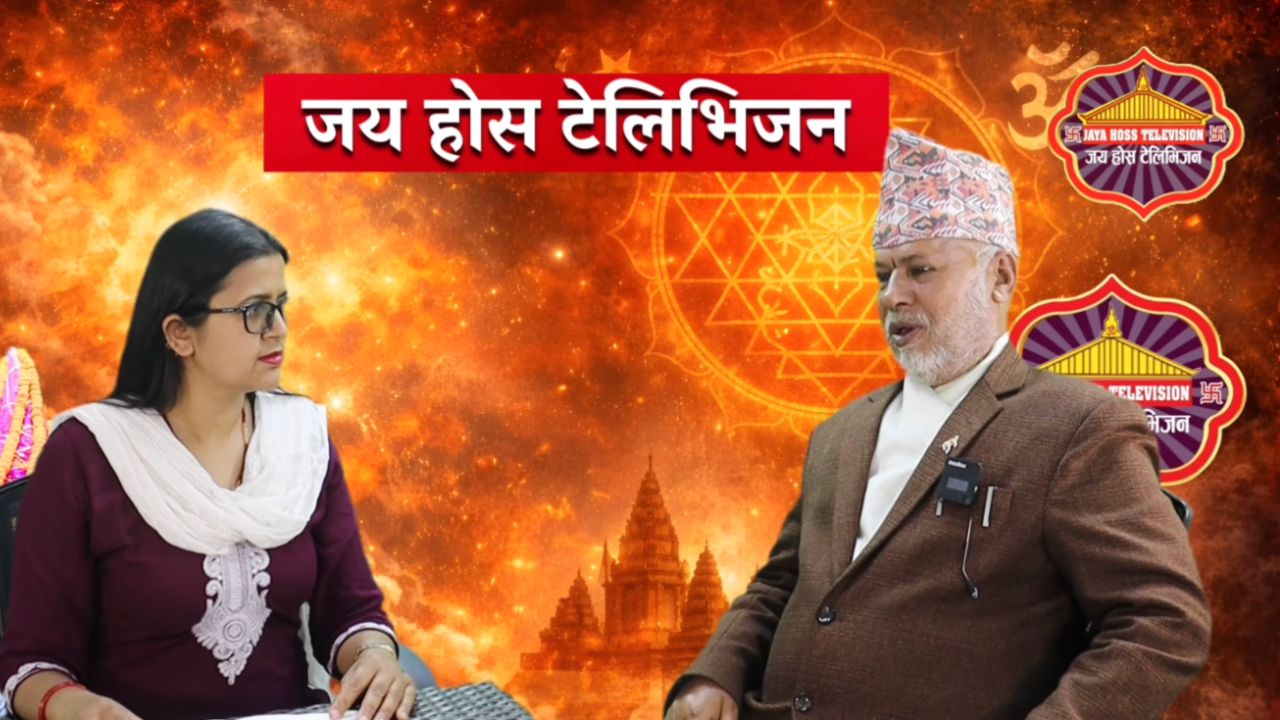
Nepal’s spiritual heritage is deeply rooted in ancient knowledge systems that continue to shape daily life, rituals, architecture, and cultural identity. In a detailed discussion on Jaya Hoss Television, renowned astrologer Pandit Ojaraj Upadhyaya Lohani shared profound insights into Jyotish Shastra, Vastu, planetary influences, and traditional remedies that remain significant in Nepali society today.
A fourth-generation Jyotishi with more than 28 years of experience, Lohani emphasized the importance of preserving authentic Vedic knowledge while avoiding superstition and commercial exploitation.
Jyotish Shastra: The “Eye” of the Vedas
According to Lohani, Jyotish Shastra is one of the six major branches of Sanskrit knowledge and is often described as the “eye” of the Vedas because it guides human beings in understanding time, destiny, and auspicious action.
Jyotish is traditionally divided into two main branches:
- Ganita Jyotish — the mathematical and astronomical aspect
- Phalit Jyotish — predictive astrology and interpretation
In Nepalese culture, astrology is not viewed merely as fortune-telling. It is traditionally used to guide important life decisions such as:
- Marriage
- House construction
- Land purchase
- Religious ceremonies
- Naming rituals
- Business openings
- Travel and auspicious timings
The discussion highlighted that astrology historically functioned as a practical guidance system closely connected with nature, cosmic cycles, and human psychology.
Vastu Shastra and the Energy of Space
A major part of the conversation focused on Vastu Shastra, the traditional science of architecture and spatial harmony.
Lohani explained that Vastu is considered a branch of Jyotish and revolves around the concept of the “Vastu Purusha,” a cosmic energy associated with the earth and living space. Traditional rituals are performed to harmonize this energy and prevent negative influences from entering a home.
According to traditional beliefs:
- East-facing and north-east-facing homes are considered favorable
- South-facing plots are often viewed as less auspicious
- Soil quality, underground water, surrounding environment, and access roads all influence a property’s energy
- Even neighboring structures and pathways can affect peace and prosperity
Astrology also classifies land according to an individual’s horoscope into:
- Friendly zones
- Neutral zones
- Enemy zones
This classification is believed to influence whether a particular property will bring harmony or difficulties to the owner.
The astrologer also noted that modern architects and researchers increasingly study Vastu principles alongside scientific environmental planning, creating a bridge between ancient wisdom and modern understanding.
Zodiac Signs and Their Associated Colors
The discussion explored the traditional relationship between zodiac signs and colors. Different colors are believed to align with the energetic tendencies of each sign.
For example:
- Aries, Leo, and Scorpio are associated with red
- Gemini is linked with green
- Cancer is connected with white
- Sagittarius and Pisces correspond with yellow
- Capricorn and Aquarius are associated with black
These colors are traditionally used in clothing, rituals, gemstones, and spiritual practices to enhance favorable energies.
The Sacred and Scientific Importance of Tulsi
Another important topic was the significance of Tulsi (Holy Basil), a sacred plant in Hindu households.
According to mythology, Tulsi is closely connected with Lord Vishnu and is considered spiritually purifying. Traditionally, Tulsi is planted in the front area of the house, especially toward the right side while exiting the home.
Lohani explained that Tulsi carries both spiritual and scientific importance:
- It purifies the air
- Helps reduce harmful microbes
- Supports immunity
- Assists with allergies and respiratory issues
- Plays a role in Ayurvedic healing
The conversation emphasized how traditional Nepali practices often integrate spirituality, Ayurveda, and environmental health into everyday living.
Understanding Manglik Dosha
One of the most discussed astrological topics in South Asia is Manglik Dosha.
In Vedic astrology, Manglik Dosha occurs when Mars occupies specific houses in the birth chart — particularly the 2nd, 4th, 7th, 8th, or 12th house.
2nd,4th,7th,8th,12th2^{nd},4^{th},7^{th},8^{th},12^{th}2nd,4th,7th,8th,12th
This condition is traditionally associated with:
- Emotional intensity
- Restlessness
- Excessive energy
- Marital conflict
- Health concerns
However, Lohani warned against oversimplified interpretations. He explained that many astrologers incorrectly judge Manglik Dosha without considering the influence of other planets, especially Jupiter.
He also stressed that simply matching two Manglik individuals for marriage is not always sufficient. Proper astrological evaluation requires deeper analysis of character, planetary strength, and overall compatibility.
Traditional remedies may include:
- Fasting
- Mantra recitation
- Ganesh worship
- Specific pujas and rituals
Still, the astrologer emphasized that planetary influences should be understood thoughtfully rather than fearfully.
Kal Sarpa Yoga and Planetary Imbalance
The discussion also covered Kal Sarpa Yoga, a condition believed to occur when all planets fall between Rahu and Ketu in a horoscope.
This alignment is associated with:
- Instability
- Sudden ups and downs
- Mental stress
- Delays and obstacles
While many people fear Kal Sarpa Yoga, Lohani explained that its effects are often exaggerated in commercial astrology. Traditional rituals may help individuals psychologically and spiritually, but blind fear should be avoided.
He encouraged people to approach astrology with balance, wisdom, and discernment.
Mool Nakshatra and Traditional Remedies
Another concept discussed was Mool Nakshatra, traditionally considered a challenging lunar constellation associated with difficult temperament and life struggles.
Traditional remedies may involve:
- Sesame seed rituals
- Herbal purification baths
- Sacred cleansing practices
- Ritual offerings
These customs have been preserved through generations as part of Nepal’s broader spiritual and cultural framework.
Astrology, Health, and Symbolism
Throughout the discussion, Lohani repeatedly connected astrology with symbolic understandings of health and human behavior.
Examples include:
- Mars representing blood and energy
- Saturn representing bones and hardship
- Moon representing the mind and emotions
While these associations are spiritual and symbolic rather than medically scientific, the astrologer argued that ancient systems attempted to understand the deep relationship between cosmic cycles and human life.
Preserving Authentic Nepali Spiritual Knowledge
One of the strongest messages from the conversation was the need to preserve authentic spiritual traditions responsibly.
Lohani expressed concern about:
- Commercial exploitation of astrology
- Fear-based predictions
- Misleading rituals
- Superstitious manipulation
Instead, he encouraged:
- Honest astrological practice
- Cultural preservation
- Respect for scripture
- Scientific openness
- Ethical spiritual guidance
According to him, Nepal’s traditional knowledge systems should evolve with modern understanding while maintaining their spiritual and cultural roots.
Conclusion
The conversation on Jaya Hoss Television offered a thoughtful exploration of Nepalese Jyotish, Vastu, rituals, and spiritual traditions through the perspective of experienced astrologer Pandit Ojaraj Upadhyaya Lohani.
Rather than promoting blind belief, the discussion emphasized balance — respecting sacred traditions while encouraging critical thinking and ethical practice.
From Vastu and Tulsi to Manglik Dosha and Kal Sarpa Yoga, the conversation reflected how deeply astrology and spirituality remain intertwined with Nepali culture, identity, and everyday life.

