
 Jyoti Bohora
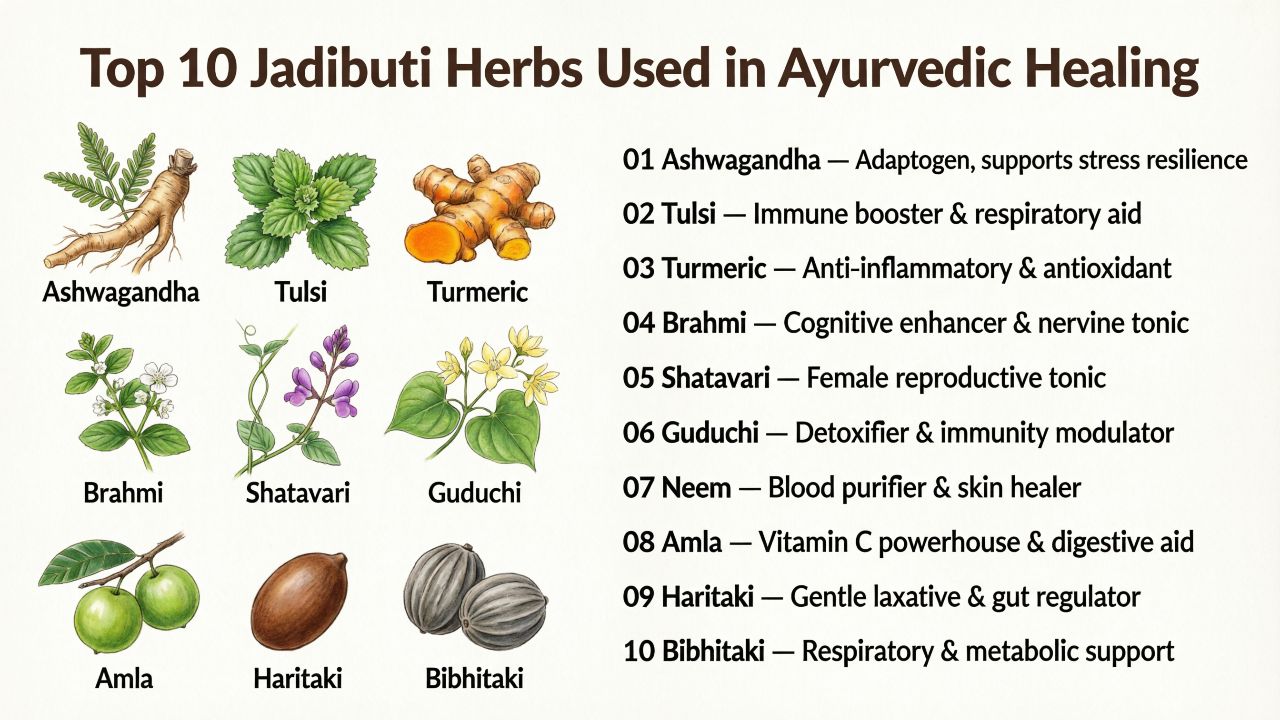
Discover the most powerful Ayurvedic herbs used in Jaya Hoss Jadibuti products. For centuries, the Himalayan foothills have served as a living apothecary, yielding botanicals that form the backbone of Ayurvedic healing. The Nepali term Jadibuti (जडीबुटी) literally translates to "medicinal herbs," reflecting a deep cultural reverence for plant-based wellness. At Jaya Hoss Jadibuti, this ancient wisdom is carefully preserved, ethically sourced, and thoughtfully formulated to support modern lifestyles without compromising traditional potency.
Below, we explore the top 10 Jadibuti herbs that have stood the test of time, backed by both classical Ayurvedic texts and contemporary research.
1. Ashwagandha (Withania somnifera)
Sanskrit Meaning: "Smell of the horse" (symbolizing strength and vitality)
Primary Action: Adaptogen, nervine tonic, rejuvenator
Ashwagandha is perhaps the most recognized Ayurvedic herb globally. Classified as a Rasayana (rejuvenative), it helps the body manage physical and mental stress by supporting healthy cortisol levels. Traditionally, it has been used to promote restful sleep, enhance stamina, and support endocrine balance. Jaya Hoss formulates Ashwagandha using root extracts harvested in the late autumn, when the plant’s withanolide concentration peaks, ensuring maximum bioavailability.
Primary Action: Adaptogen, nervine tonic, rejuvenator
Ashwagandha is perhaps the most recognized Ayurvedic herb globally. Classified as a Rasayana (rejuvenative), it helps the body manage physical and mental stress by supporting healthy cortisol levels. Traditionally, it has been used to promote restful sleep, enhance stamina, and support endocrine balance. Jaya Hoss formulates Ashwagandha using root extracts harvested in the late autumn, when the plant’s withanolide concentration peaks, ensuring maximum bioavailability.
2. Haridra / Turmeric (Curcuma longa)
Sanskrit Meaning: "The golden spice"
Primary Action: Anti-inflammatory, antioxidant, blood purifier
More than a kitchen staple, Haridra is a cornerstone of Ayurvedic detoxification. Its active compound, curcumin, works synergistically with piperine and natural fats to support joint mobility, skin clarity, and digestive comfort. In classical practice, turmeric is rarely used in isolation; Jaya Hoss blends it with complementary herbs like black pepper and ginger to enhance absorption and align with traditional Anupana (vehicle) principles.
Primary Action: Anti-inflammatory, antioxidant, blood purifier
More than a kitchen staple, Haridra is a cornerstone of Ayurvedic detoxification. Its active compound, curcumin, works synergistically with piperine and natural fats to support joint mobility, skin clarity, and digestive comfort. In classical practice, turmeric is rarely used in isolation; Jaya Hoss blends it with complementary herbs like black pepper and ginger to enhance absorption and align with traditional Anupana (vehicle) principles.
3. Tulsi / Holy Basil (Ocimum tenuiflorum)
Sanskrit Meaning: "The Incomparable One"
Primary Action: Immunomodulator, respiratory support, mental clarity
Revered in South Asian households as a sacred plant, Tulsi is a gentle yet powerful adaptogen. It supports lung function, promotes clear breathing, and helps maintain balanced blood sugar levels. Regular consumption is believed to calm the mind while sharpening focus. Jaya Hoss sources wild-crafted Tulsi leaves from mid-hill regions, where cooler temperatures and clean air preserve the herb’s essential oils and eugenol content.
Primary Action: Immunomodulator, respiratory support, mental clarity
Revered in South Asian households as a sacred plant, Tulsi is a gentle yet powerful adaptogen. It supports lung function, promotes clear breathing, and helps maintain balanced blood sugar levels. Regular consumption is believed to calm the mind while sharpening focus. Jaya Hoss sources wild-crafted Tulsi leaves from mid-hill regions, where cooler temperatures and clean air preserve the herb’s essential oils and eugenol content.
4. Brahmi (Bacopa monnieri)
Sanskrit Meaning: "Consciousness" or "Creative Intelligence"
Primary Action: Nootropic, neuroprotective, memory enhancer
Brahmi is the scholar’s herb in Ayurveda. Rich in bacosides, it supports synaptic communication, promotes mental endurance, and helps ease occasional anxiety. It’s traditionally consumed as a tea or powder alongside warm milk to nourish Majja Dhatu (nervous tissue). Jaya Hoss processes Brahmi using low-temperature drying to protect its delicate alkaloid profile, making it a staple in our cognitive wellness line.
Primary Action: Nootropic, neuroprotective, memory enhancer
Brahmi is the scholar’s herb in Ayurveda. Rich in bacosides, it supports synaptic communication, promotes mental endurance, and helps ease occasional anxiety. It’s traditionally consumed as a tea or powder alongside warm milk to nourish Majja Dhatu (nervous tissue). Jaya Hoss processes Brahmi using low-temperature drying to protect its delicate alkaloid profile, making it a staple in our cognitive wellness line.
5. Neem (Azadirachta indica)
Sanskrit Meaning: "Reliever from sickness"
Primary Action: Blood purifier, antimicrobial, skin supporter
Neem leaves and bark are deeply detoxifying, particularly for Pitta and Kapha imbalances. It has been used for centuries to support clear skin, healthy digestion, and oral hygiene. Its bitter principle stimulates Agni (digestive fire) while gently cleansing the liver. Jaya Hoss utilizes neem in carefully balanced ratios, as its potency requires mindful dosing to avoid over-drying. It features prominently in our seasonal cleansing protocols.
Primary Action: Blood purifier, antimicrobial, skin supporter
Neem leaves and bark are deeply detoxifying, particularly for Pitta and Kapha imbalances. It has been used for centuries to support clear skin, healthy digestion, and oral hygiene. Its bitter principle stimulates Agni (digestive fire) while gently cleansing the liver. Jaya Hoss utilizes neem in carefully balanced ratios, as its potency requires mindful dosing to avoid over-drying. It features prominently in our seasonal cleansing protocols.
6. Triphala (Phyllanthus emblica, Terminalia chebula, Terminalia bellirica)
Sanskrit Meaning: "Three fruits"
Primary Action: Gentle laxative, antioxidant, tridoshic rasayana
Triphala is not a single herb but a synergistic blend of Amalaki, Bibhitaki, and Haritaki. Together, they support regular elimination, nourish the digestive tract, and provide broad-spectrum antioxidants. Unlike harsh laxatives, Triphala works gradually, strengthening Apana Vata (downward-moving energy) without dependency. Jaya Hoss sources each fruit from certified organic farms in the Terai region, where soil richness ensures optimal tannin and vitamin C content.
Primary Action: Gentle laxative, antioxidant, tridoshic rasayana
Triphala is not a single herb but a synergistic blend of Amalaki, Bibhitaki, and Haritaki. Together, they support regular elimination, nourish the digestive tract, and provide broad-spectrum antioxidants. Unlike harsh laxatives, Triphala works gradually, strengthening Apana Vata (downward-moving energy) without dependency. Jaya Hoss sources each fruit from certified organic farms in the Terai region, where soil richness ensures optimal tannin and vitamin C content.
7. Guduchi / Giloy (Tinospora cordifolia)
Sanskrit Meaning: "Protector of the body"
Primary Action: Immunomodulator, hepatoprotective, fever reducer
Guduchi’s vine-like stems are prized for their ability to support immune resilience and liver function. In classical texts, it’s described as Amrita (nectar) for its capacity to help the body recover from seasonal challenges. Modern research highlights its diterpenoid compounds, which exhibit adaptogenic and anti-stress properties. Jaya Hoss processes Guduchi using traditional decoction methods, preserving its water-soluble polysaccharides for optimal absorption.
Primary Action: Immunomodulator, hepatoprotective, fever reducer
Guduchi’s vine-like stems are prized for their ability to support immune resilience and liver function. In classical texts, it’s described as Amrita (nectar) for its capacity to help the body recover from seasonal challenges. Modern research highlights its diterpenoid compounds, which exhibit adaptogenic and anti-stress properties. Jaya Hoss processes Guduchi using traditional decoction methods, preserving its water-soluble polysaccharides for optimal absorption.
8. Shatavari (Asparagus racemosus)
Sanskrit Meaning: "She who possesses a hundred husbands" (symbolizing vitality and fertility)
Primary Action: Female reproductive tonic, moisturizing, cooling
Shatavari is a cornerstone of women’s wellness in Ayurveda. Its root tubers contain saponins and phytoestrogens that support hormonal balance, lubricate tissues, and promote emotional calm. It’s equally valued for nourishing Rasa Dhatu (plasma) and supporting healthy lactation. Jaya Hoss harvests Shatavari roots during the dormant season, ensuring maximum starch and alkaloid retention for gentle, sustained nourishment.
Primary Action: Female reproductive tonic, moisturizing, cooling
Shatavari is a cornerstone of women’s wellness in Ayurveda. Its root tubers contain saponins and phytoestrogens that support hormonal balance, lubricate tissues, and promote emotional calm. It’s equally valued for nourishing Rasa Dhatu (plasma) and supporting healthy lactation. Jaya Hoss harvests Shatavari roots during the dormant season, ensuring maximum starch and alkaloid retention for gentle, sustained nourishment.
9. Guggul (Commiphora mukul)
Sanskrit Meaning: "To protect from disease"
Primary Action: Lipid metabolism support, joint comfort, detoxifier
Guggul resin, tapped from the Mukul myrrh tree, has been used for over 2,000 years to support healthy cholesterol levels and joint mobility. Its guggulsterones help stimulate thyroid function and promote the clearance of Ama (metabolic toxins). Due to sustainability concerns, Jaya Hoss partners with ethical tappers in arid Himalayan zones, using wild-harvesting permits and replanting initiatives to ensure long-term ecological balance.
Primary Action: Lipid metabolism support, joint comfort, detoxifier
Guggul resin, tapped from the Mukul myrrh tree, has been used for over 2,000 years to support healthy cholesterol levels and joint mobility. Its guggulsterones help stimulate thyroid function and promote the clearance of Ama (metabolic toxins). Due to sustainability concerns, Jaya Hoss partners with ethical tappers in arid Himalayan zones, using wild-harvesting permits and replanting initiatives to ensure long-term ecological balance.
10. Yashtimadhu / Mulethi (Glycyrrhiza glabra)
Sanskrit Meaning: "Sweet root"
Primary Action: Demulcent, respiratory soother, adrenal supporter
Licorice root is nature’s harmonizer. Its sweet taste (Madhura Rasa) balances bitterness in formulations, soothes irritated mucous membranes, and supports healthy adrenal function. It’s traditionally used for coughs, throat discomfort, and digestive acidity. Jaya Hoss uses deglycyrrhizinated extracts in select products to offer gentle relief without affecting blood pressure, staying true to both traditional wisdom and modern safety standards.
Primary Action: Demulcent, respiratory soother, adrenal supporter
Licorice root is nature’s harmonizer. Its sweet taste (Madhura Rasa) balances bitterness in formulations, soothes irritated mucous membranes, and supports healthy adrenal function. It’s traditionally used for coughs, throat discomfort, and digestive acidity. Jaya Hoss uses deglycyrrhizinated extracts in select products to offer gentle relief without affecting blood pressure, staying true to both traditional wisdom and modern safety standards.
The Jadibuti Philosophy: Tradition Meets Transparency
What sets Jaya Hoss Jadibuti apart isn’t just the herbs themselves, but how they’re handled. Each batch undergoes:
- Botanical authentication via microscopic and HPLC testing
- Cold-press or low-heat extraction to preserve volatile compounds
- Dosha-aware formulation guided by classical Vaidya consultations
- Ethical wildcrafting & organic farming partnerships across Nepal and the Indian subcontinent
Ayurveda doesn’t view herbs as isolated fixes, but as allies in restoring Prakriti (natural balance). The true power of Jadibuti lies in consistency, mindful preparation, and alignment with daily rhythms (Dinacharya).
Bringing Ancient Wisdom Into Your Routine
Incorporating these herbs doesn’t require a complete lifestyle overhaul. Start with one or two that align with your current wellness goals, pair them with seasonal routines, and allow 4–8 weeks for subtle, cumulative shifts. Whether you’re sipping Tulsi at dawn, taking Triphala before rest, or supporting recovery with Ashwagandha, the journey is as important as the destination.
At Jaya Hoss Jadibuti, we believe healing is a return to rhythm. Our formulations are crafted to meet you where you are, grounded in centuries of Himalayan wisdom and refined for today’s world.
Explore our curated Jadibuti collections, learn about seasonal herbal practices, and discover how traditional Ayurveda can support your modern wellness journey.
Disclaimer: Ayurvedic herbs support holistic wellness and are not intended to diagnose, treat, cure, or prevent any disease. Consult a qualified healthcare provider or Ayurvedic practitioner before beginning any new herbal regimen, especially if you are pregnant, nursing, taking medication, or managing a chronic condition.